
As tech keeps speeding up, all of us think about the future. By looking at where people agree and disagree, we can get some exploratory ideas of what might happen and what these possible futures could mean. I collected and analyzed over 10K online interactions and predictions about the next couple of decades . Idea was not just about what might change, but how these changes could transform how we lives.
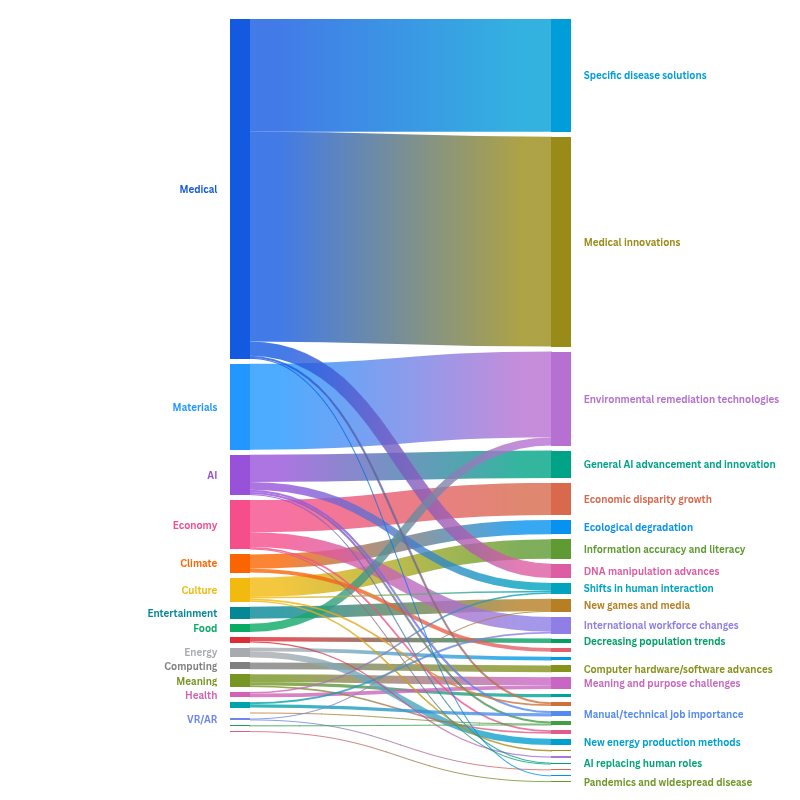
Here is summarized visualization based on data I collected showing prediction archetypes (left) and emerging themes (right), with connection widths displaying engagement level. Medical innovations and AI advancements generate the most discussion across multiple domains
Made using
The Two Sides of Our Future
Imagine: It’s 2054. Jian Li (58) witnessed his parents lose their software engineering and corporate accounting jobs to automation in the 2020s, an experience that shaped his view of technology as both miracle and disruptor. Now a “human-machine integration specialist”, Jian has successfully navigated the economic transition that left many behind.
This captures the central findings from the analysis: technological advancement doesn’t guarantee universal progress. Each breakthrough promising to solve humanity’s challenges potentially deepens our most persistent problems.
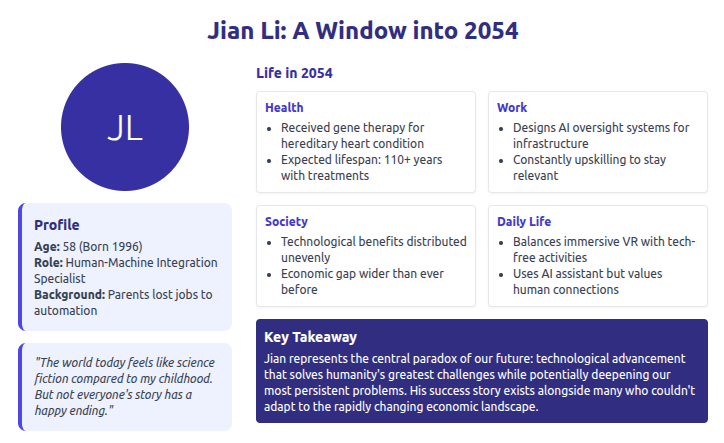
Future Personas based on varied predictions from users comments & discussion
Technological Milestones: Two Possible Futures (2025-2054) based on the analysis and supportive findings.
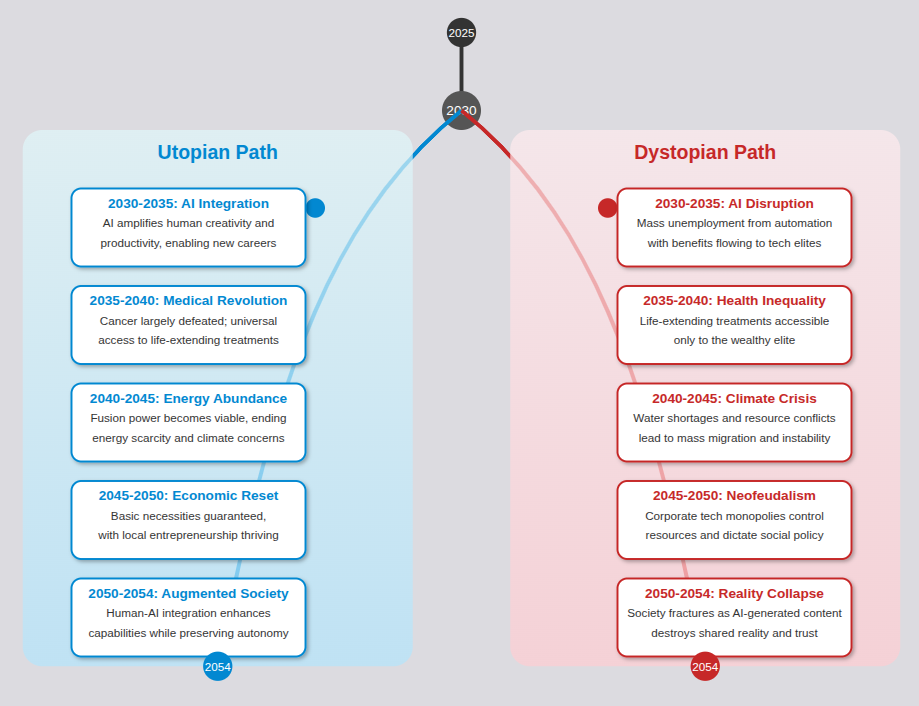
Based analysis on 10K+ comments related to future prediction
Better Health for Everyone: Medicine’s Big Breakthrough
The most immediate and tangible changes ahead involve the transformation of human health. Findings indicates that possibly we are entering an era where many conditions previously considered permanent may become temporary inconveniences.
“It’s happening with my dad right now… they drew blood, concocted a ‘potion’ of medicine tailored to his immune system, then he had an infusion… He’s gonna do this six times over 12 weeks, and the cancer should either be small enough to remove or gone completely.” — Reddit user
By the 2050s, the medical landscape potentially unrecognizable compared to today:
- Tooth regeneration technology augmenting traditional dentistry
- Lab-grown organs eliminating transplant waiting lists and rejection issues
- Personalized cancer treatments using mRNA technology targeting individual tumors
- GLP-1 medications (like semaglutide) revolutionizing treatment of obesity, addiction, and mental health
- CRISPR and gene editing fundamentally altering disease prevention
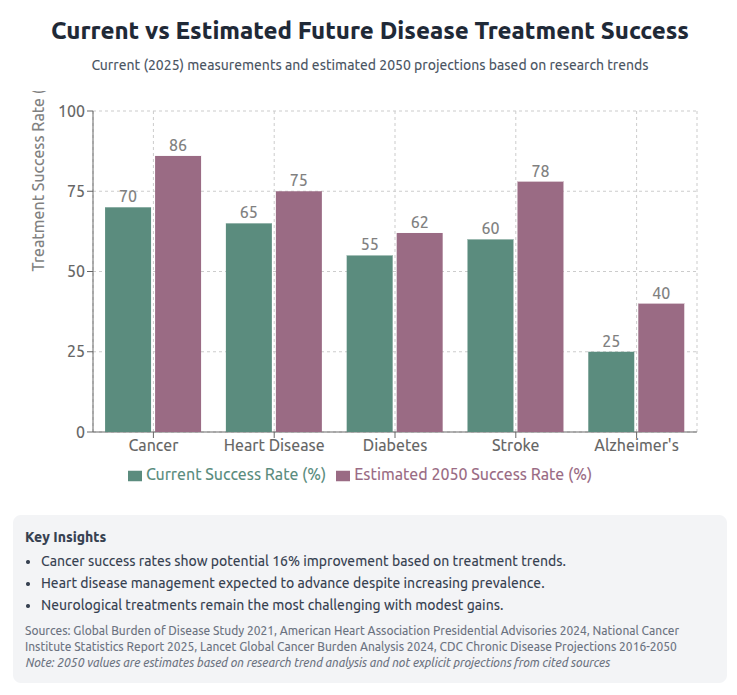
The implications extend far beyond convenience. Cancer probably become ~90% treatable. People will live longer, healthier lives with treatments tailored to their genetic makeup. But these advancements raise deep questions: Who will have access to these life-extending technologies? What happens to society when the wealthy potentially live decades longer than the poor?
The Economic Shift: Work’s Changing Role
Perhaps no aspect of the coming decades creates more uncertainty than the transformation of work we all do. Findings suggest that AI is expected to drive massive automation across all sectors of the economy.
“When one guy (or a few shareholders) own an AI that can do the work of a whole INDUSTRY of people it’s going to be a few trillionaires and then everybody else.”
This isn’t merely about job loss, it’s about a fundamental restructuring of how humans contribute and derive meaning. The disruption potentially be widespread based on discussions I analyzed:
- Traditional knowledge work (accounting, coding, content creation) faces significant automation
- Transportation jobs will transform with autonomous vehicles becoming mainstream
- Creative fields may shift from creation to curation as AI generates more content
But not all predictions are gloomy. Some envision AI enabling “hyper-local, AI-powered entrepreneurship,” potentially supercharging millions of small businesses. Even more radical is the notion that as robots and AI perform most labor, necessities like food and housing could be provided as a human right, with money only required for luxuries.
The Environment: When Crisis Meets Innovation
While technological disruption are most discussed, our relationship with the natural world may undergo changes as well. The coming decades present both challenges and a critical window for course correction.
“World-wide water shortages. Priced like oil.”
The environmental challenges ahead demand our immediate attention:
- Water scarcity becoming a central geopolitical issue
- Declining agricultural fertility threatening global food security
- Climate migration potentially displacing millions of people
- Extreme weather events increasing in frequency and severity
Yet these very challenges are catalyzing innovations that could help us course-correct:
- Algae-based materials revolutionizing packaging and carbon capture
- Magnetic cooling technology eliminating harmful refrigerants while improving efficiency
- Advanced recycling systems for critical metals and materials
“Algae based products will help cut down on plastic waste… algae farming is going to revolutionize climate control.”
What’s clear from the data is that technology alone won’t save us. Without widespread environmental awareness and conscious collective action, these innovations will remain niche solutions to systemic problems.
The window for meaningful action is narrowing. As one commenter noted regarding climate impacts: “This collapse is happening now,” citing insurance companies already withdrawing from high-risk areas . Without heightened awareness and prioritization of environmental concerns, we risk missing our opportunity to redirect our course.
How Technology Will Change Our Social Lives
The way we connect with other people is going to change dramatically. As technology changes how we work, stay healthy, and make money, it will also change how we make friends, find meaning in life, and build communities.
“New communities forming around shared values rather than geography” - “some will chose to live without AI, kinda like modern Amish societies”
The possible shifts in social dynamics:
- Declining sense of meaning as traditional sources of identity erode
- Technology intensifying isolation while creating illusions of connection
- New communities forming around shared values rather than geography
- Redefinition of care systems as demographic shifts require new support structures
- Potential machine rights movements as emotional connections to AI systems develop
Perhaps most striking is the prediction that " there will probably be a machine rights movement that starts in the next 10 to 20 years" as people form emotional attachments to increasingly human-like AI.
Reality Blurs: Truth in the Digital Age
Beyond concerns about job loss from AI, a striking fear is the predicted collapse of shared reality and which we already started to experience. The line between what is “real” and “artificial” will increasingly blur due to AI-generated content.
“The internet will no longer be a good source of information and education. You can already find AI written articles that seem reputable if you don’t already know a lot about the subject, only then do you realize the information given is wrong and in some cases dangerous.”
The technology-driven changes to our perception of reality will be profound:
- AI-generated media will become indistinguishable from human-created content
- Personalized entertainment means fewer shared cultural touchpoints
- Virtual and augmented reality will create immersive alternate worlds
- Digital companions will form emotional relationships with humans
- Deep fakes and misinformation will challenge fundamental trust in information
The future will likely bring both amazing opportunities and real challenges. The most consistent prediction across all sources is inconsistency itself; breakthroughs will benefit some areas while others face disruption.
Looking at our example person Jian Li, we see someone who did well during these big changes. He got medical help for his heart problem, shifted his career as old jobs disappeared, and lives comfortably, but he sees many others struggling.
The big questions we face include:
- How to share the benefits of new technology more fairly
- How to stay connected as humans in a digital world
- What values should guide us with powerful new technologies
- How to protect truth when artificial content is everywhere