
- The “overnight success” of NFC actually took 12 years of manufacturer hesitation
- Budget phones, not premium flagships, actually drive new feature adoption
- Some “revolutionary” features like wireless charging remain stuck below 50% adoption after 16+ years
- Battery technology improved 900% over 25 years, yet consumers still complain about battery life
- 2015 was mobile’s greatest year with 2,217 device launches - never matched before or since
I recently analyzed a massive dataset of 24,653 devices (credit Kaggle ) released between 1999 and 2025. This is not consumer sales or opinion data, it’s seller-side information revealing what manufacturers chose to build and when. The patterns that emerged challenge fundamental assumptions about how innovation actually works in the mobile industry.
The Premium Phone Paradox
Perhaps no finding challenges conventional wisdom more than the role of budget phones in driving innovation adoption.
The Surface Story vs. The Real Story
At first glance, premium phones seem to lead innovation: Wireless charging: Premium (24.3%) > Mid-range (12.7%) > Budget (6.2%)
But this misses the dynamic truth. Budget phones are closing gaps at accelerating rates , and they are doing so at massive scale. If 100 premium phones adopt a feature at 60% penetration, that’s 60 devices. But 1,000 budget phones at 40% penetration means 400 devices, nearly seven times the ecosystem impact.
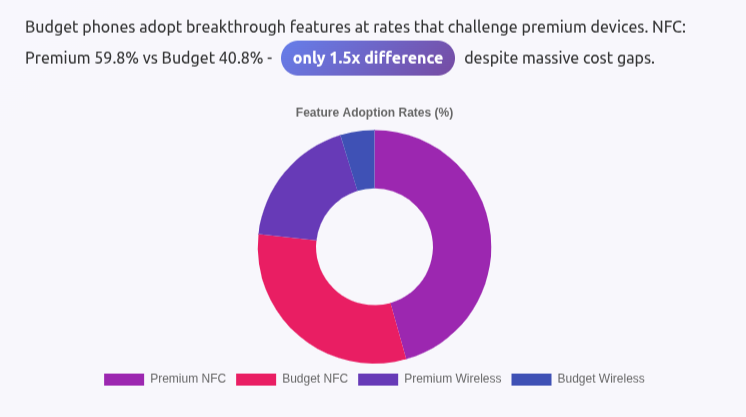
The NFC data shows something even more striking:
- Premium phones: 59.8% adoption
- Budget phones: 40.8% adoption
- Mid-range phones: 39.7% adoption
Budget phones actually outpace mid-range devices. Why? Because budget phones operate on thin margins where small advantages matter enormously. Once infrastructure exists, like NFC payment terminals everywhere, adding the feature costs low but provides huge competitive advantage.
*Adoption indicates % of features or tech roll out across devices launched and not consumer use
The 12-Year “Overnight Success” of NFC
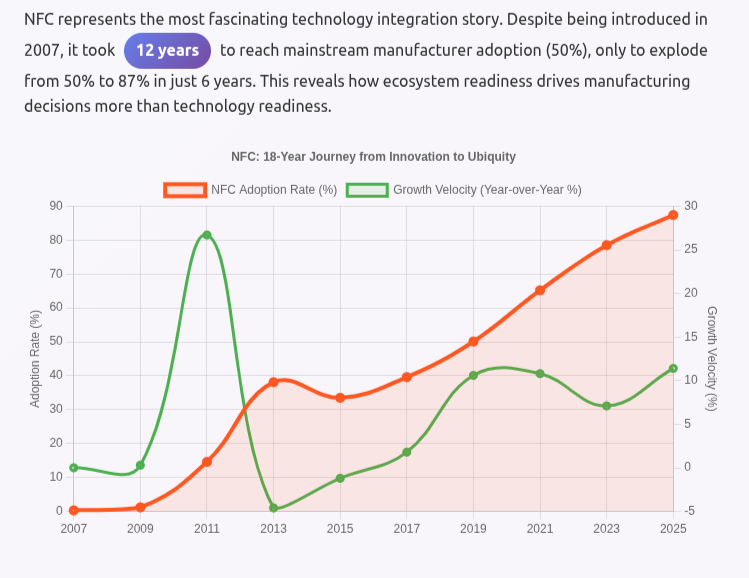
NFC represents possibly the most instructive case study in the entire dataset. Introduced in 2007 when Nokia quietly added NFC to the 6131 model, it took 12 years to reach mainstream adoption. The journey reveals why some innovations take forever to succeed.
Phase 1: The Dormant Years (2007-2010)
NFC existed as technology without purpose. Adoption flatlined at 0.4% of devices. Nokia had built a solution for a problem that didn’t yet exist - no payment infrastructure, no consumer understanding, no ecosystem support.
Phase 2: The False Dawn (2011-2014)
Google Wallet’s launch sparked genuine optimism:
- Manufacturer adoption surged from 14.6% to 38.1%
- By 2014: 548 phones included NFC (out of 1,440 total)
- But merchants lacked terminals
- Carriers blocked Google Wallet
- Banks worried about security
- The revolution stalled
Phase 3: The Apple Paradox (2015-2018)
When Apple added NFC for Apple Pay, yet growth was just 6.1 percentage points over four years. Why? Apple’s entry fragmented rather than unified the ecosystem. Competing standards confused merchants. Platform wars delayed necessary coordination.
Phase 4: The Renaissance (2019-2025)
COVID-19 became the unexpected catalyst:
- Adoption exploded from 50.1% to 87.4%
- Contactless payments shifted from convenience to necessity
- Transit systems integrated NFC globally
- Today: 216 out of 247 new phones include NFC
The lesson is clear: ecosystem readiness beats technological readiness every time.
The Revolution Nobody Talks About
Modern smartphones achieve something that would have seemed physically impossible in 2000: they pack 10 times more battery capacity per millimeter of thickness than early devices.
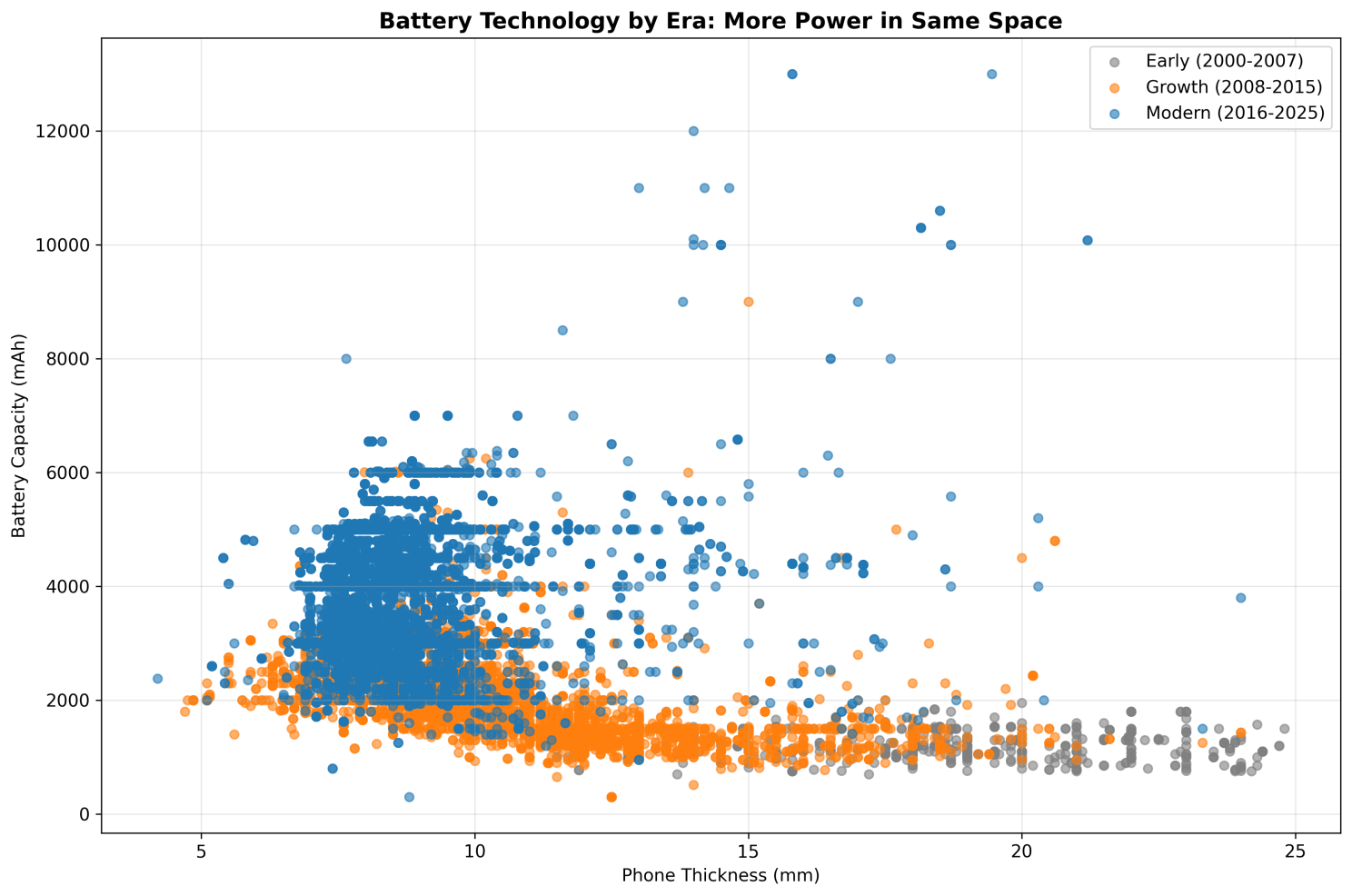
Yet despite these miraculous improvements, battery anxiety remains universal. Why?
The data reveals that phones became 54% thinner while batteries grew 237% larger. Engineers performed the equivalent of fitting a swimming pool’s worth of water into a bathtub-sized container. But each improvement enabled new power-hungry features that immediately consumed the gains. When 2002’s battery breakthrough arrived, manufacturers added color screens. When 2012’s efficiency gains appeared, they enabled 4G radios and multi-core processors. By 2013, phones were shooting 4K video and running desktop-class applications.
As one analysis noted, we went from wanting phones that could “please last 6 hours” to expecting devices that could “stream Netflix for 12 hours while running 47 apps.” The revolution succeeded so well that it made itself invisible.
The Graveyard of “Revolutionary” Features
Not every innovation succeeds. The data reveals clear patterns distinguishing features that thrive from those that languish.
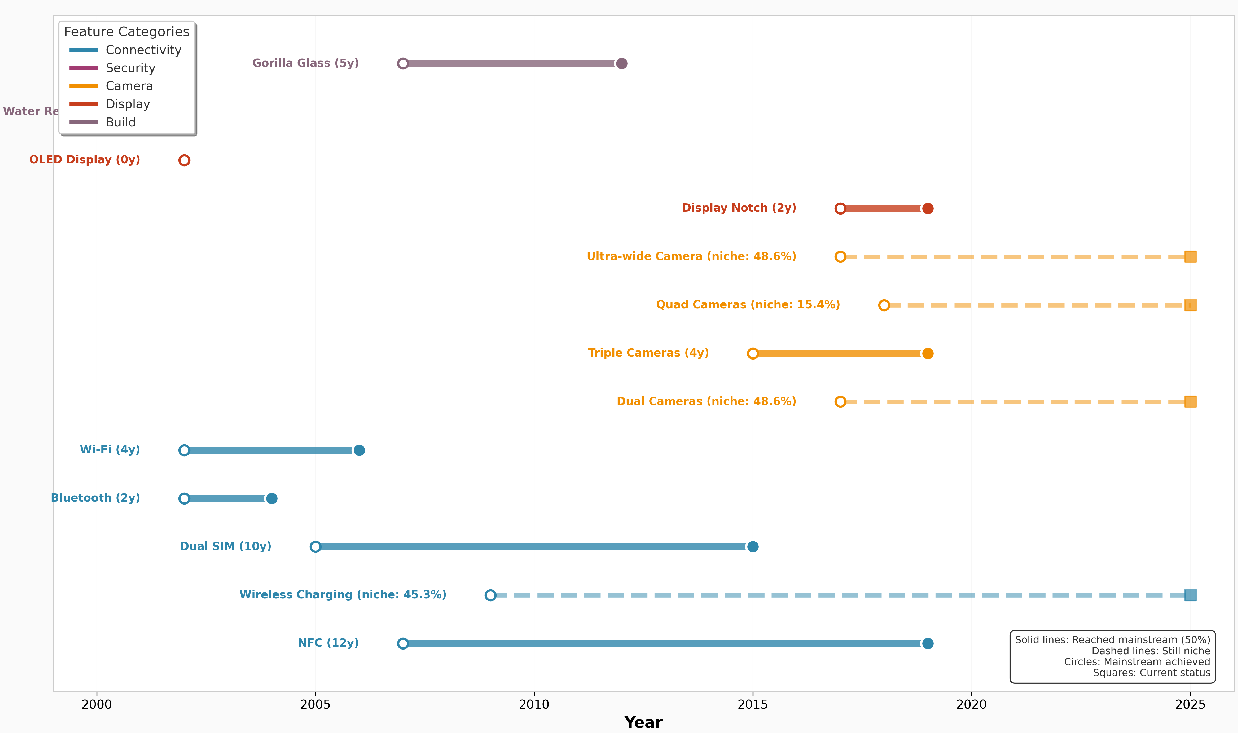
Feature Adoption Timeline (Adoption, measured % of feature across devices)
Wireless Charging: The 16-Year Struggle
Despite appearing in 2009 (before Instagram existed), wireless charging remains stuck at 45.3% adoption after 16 years. The brand data tells the story:
- Apple : 100% adoption (closed ecosystem advantage)
- Samsung : 53.1% (hedging their bets)
- OnePlus : 27.2% (cost optimization priority)
- Others : <20% (not worth the cost)
The problems compound: charging is 2-3x slower than wired, competing standards confuse consumers, and the “convenience” requires carrying charging pads. It’s a solution still searching for its problem.
The 8-12 Year Rule
One pattern emerges consistently: successful features take 8-12 years to reach 50% adoption. The timeline depends entirely on ecosystem complexity:
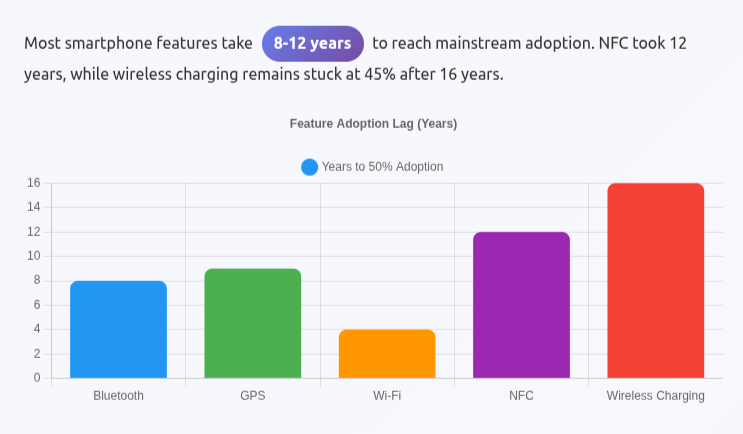
Fast Success (0-5 years):
- Face Recognition: Clear security benefit, no infrastructure needed
- Fingerprint Sensors: Obvious utility, manufacturer controlled
- Better cameras: Immediate gratification, no dependencies
Moderate Timeline (6-10 years):
- GPS: Required satellite coverage and power management
- 4G: Infrastructure rollout dependent
Long Journey (11+ years):
- NFC: Complex ecosystem of banks, merchants, and standards
- Wireless Charging: Performance compromises without clear benefits
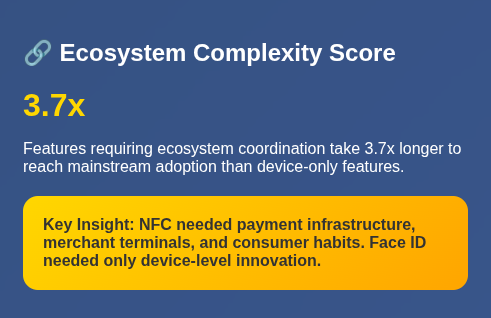
The pattern is crystal clear: features needing only the phone succeed fast . Features requiring infrastructure, behavior change, or ecosystem coordination take a decade or fail entirely.