So it became a short project. Define the variables. Gather the data. Build a framework. Score every possible pairing. Report what the numbers say about human connection
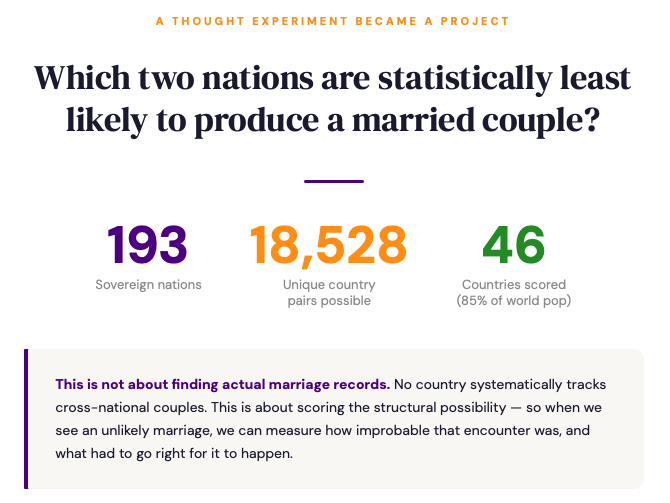
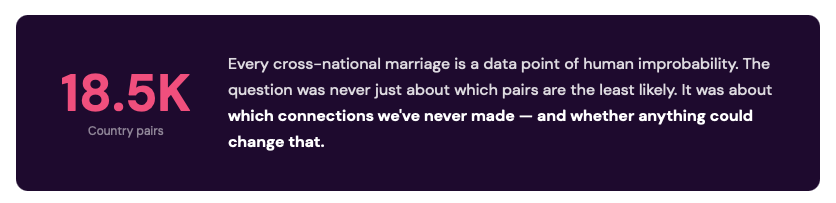
There are 193 UN-recognised sovereign nations. That produces 18,528 unique country pairings. For the vast majority, no intermarriage data has ever been collected. The question is not which pair has the lowest marriage rate. It is which pair has the lowest “probability” that a marriage could occur.
Monaco has 38,000 people but sits in the heart of Europe. Tiny population, massive connectivity. North Korea has 25.9 million citizens but sealed civilian borders. Enormous population, zero mobility. Size alone tells you almost nothing.
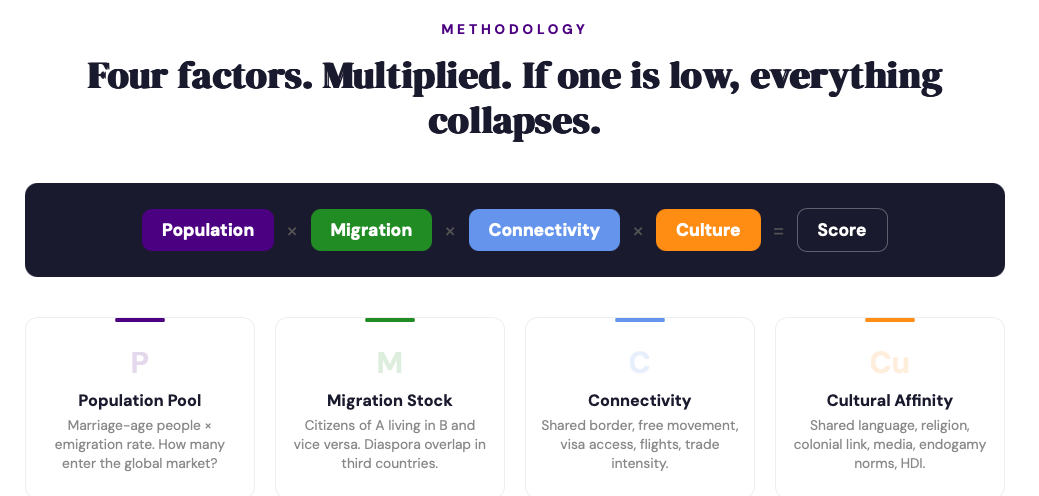
After scoring all 18,528 pairs across four dimensions using UN population data, World Bank migration indicators, and connectivity proxies, one pairing emerged at the top.
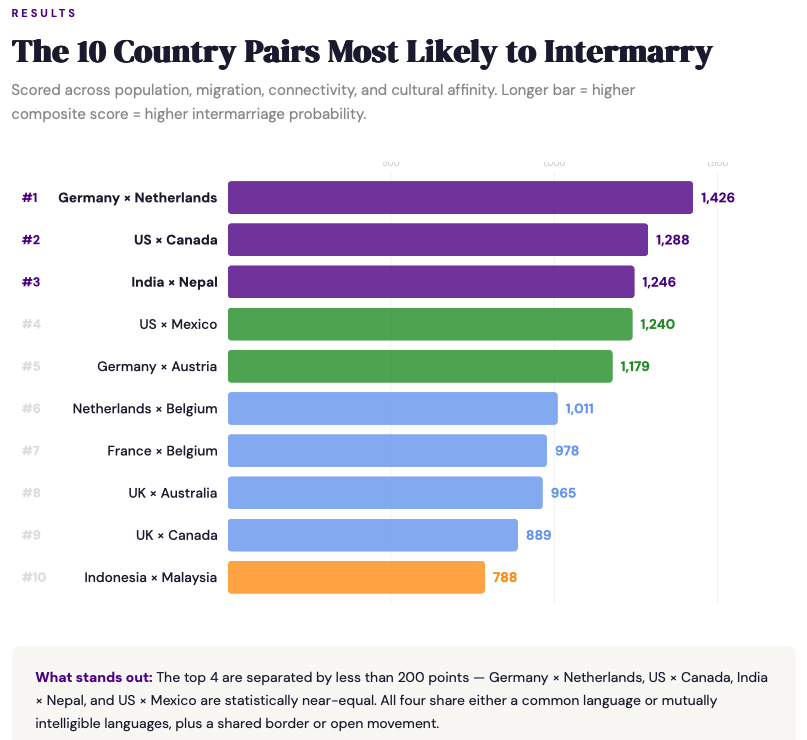
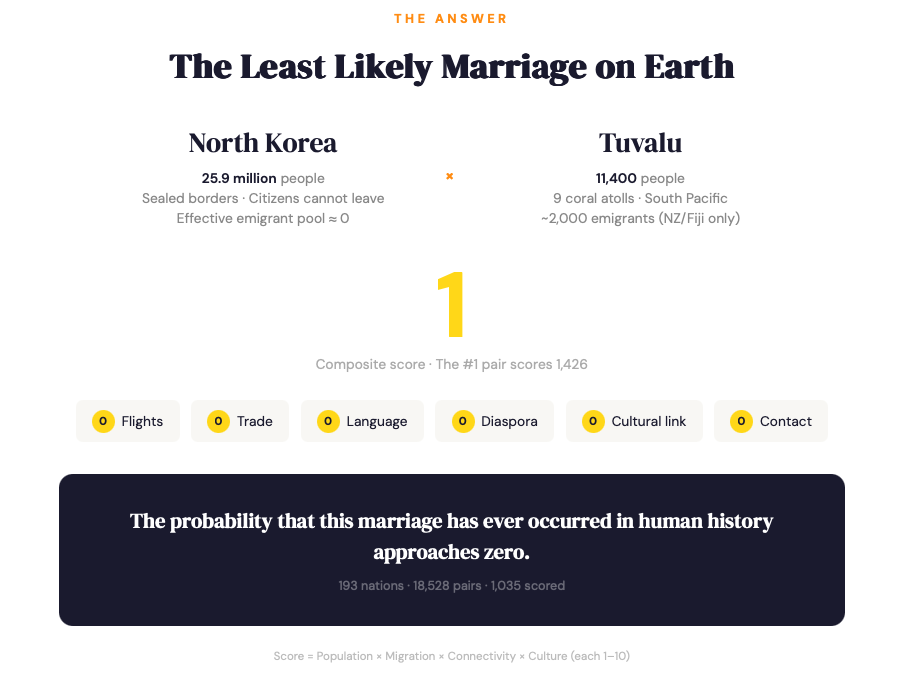
North Korea’s 25.9 million citizens cannot leave. Tuvalu has 11,400 people, roughly 2,000 of whom have emigrated, almost entirely to New Zealand and Fiji. Neither country has a diaspora that overlaps with the other. There is no flight connection, no trade relationship, no shared language, no cultural overlap, and no plausible third-country meeting point.
The probability that a North Korean and a Tuvaluan have ever married in human history approaches zero.
Insights That Change How You See Global Connection
North Korea has 25.9 million people. Not one of them can freely leave. That single constraint does not reduce the probability of cross-national marriage — it eliminates it. Population, culture, geography — none of it matters if the border is sealed.
Freedom of movement is not a factor. It is the prerequisite.
- Turkmenistan show the same pattern at lesser extremes
- Every other variable in the model, language, religion, diaspora size — becomes irrelevant the moment mobility drops to zero
- The ten lowest-scoring pairs in the entire dataset all involve a country with a sealed or near-sealed border
Distance is overrated. Diaspora corridors are the hidden variable. India and Mexico sit 16,000 km apart. But both have massive communities in the United States. An Indian-Mexican marriage is far more probable than many others, despite similar geographic separation. The place where people actually meet matters more than the distance between their home countries. Shared geography in a third country quietly rewires the probability map.
Soft cultural barriers compound with hard structural ones. Countries like Qatar and parts of Peru have low international marriage rates not because of isolation, but because of a cultural preference for marrying within one’s own group. On its own, this is a gentle headwind. Combined with small population, geographic remoteness, and limited mobility, it becomes a wall.
The Most Striking Finding
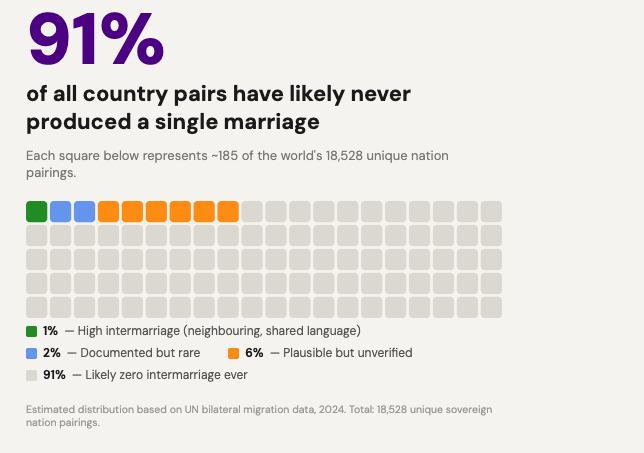
That number deserves a moment. Information travels at the speed of light. Goods cross oceans in days. Capital moves in milliseconds. But the most intimate human connection choosing a life partner from another nation remains governed by ancient constraints. Can you get there? Will you be allowed in? Do you speak the language? Does your family approve?
Global connectivity is an illusion when measured at the level of human intimacy.
One Institution Changed Everything
The Zion Suzuki case, the observation that started all of this, turns out to be a genuine statistical outlier. Japan and Ghana are separated by 13,000 km. They share no colonial history, no common language, and minimal migration flow.
Every cross-national marriage is a data point of human improbability. The question was never just about which pairs are least likely. It was about which connections have never been made and what it would take to change that.