
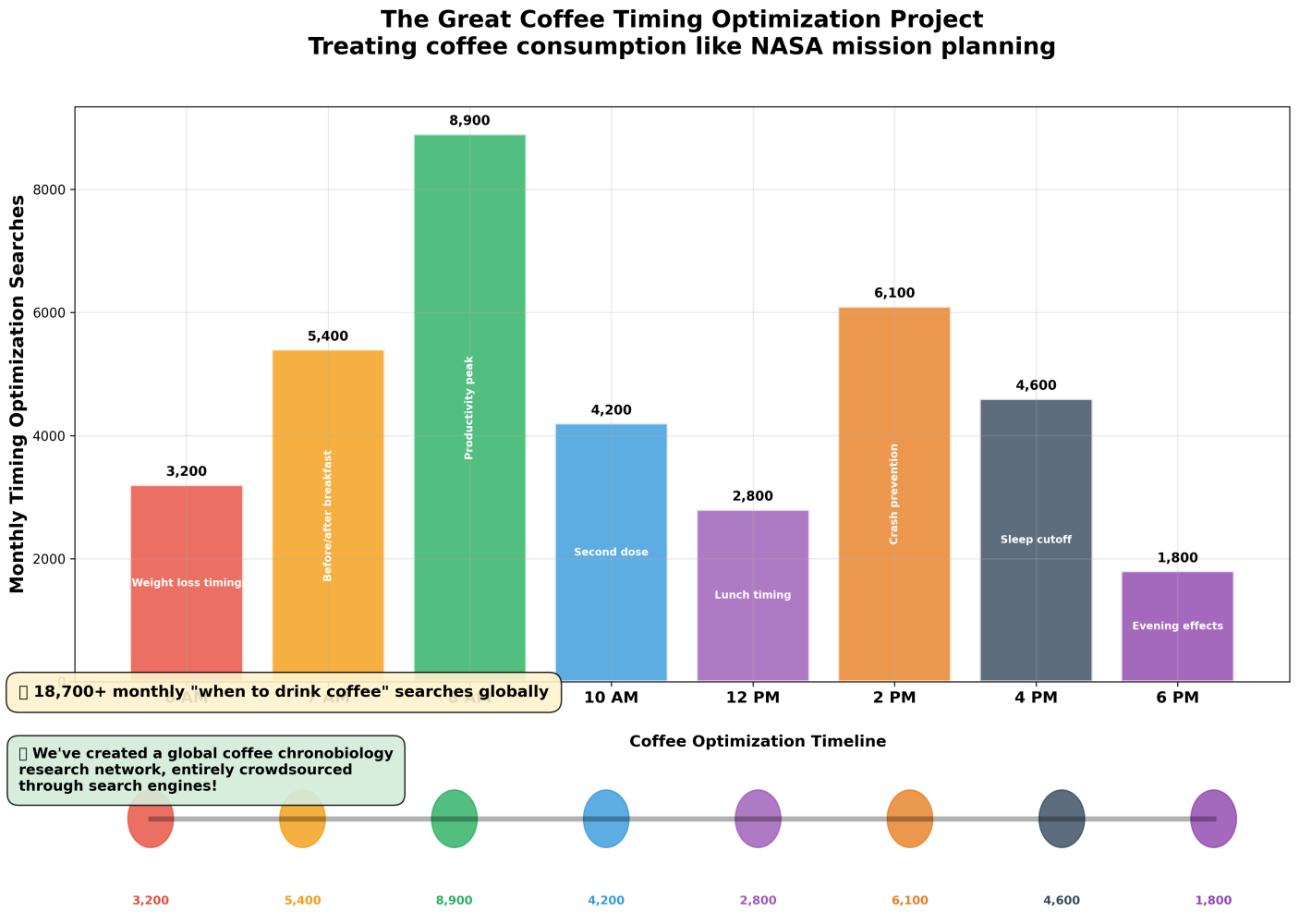
The Data:
How I read the data without letting one country shout over everyone else
I blended two sources for six markets (USA, India, UAE, Norway, Sweden, Colombia). Data retrieved using pytrends python library:
- Search suggestion lists for the long tail and phrasing nuance.
- Monthly search volume tables for scale.
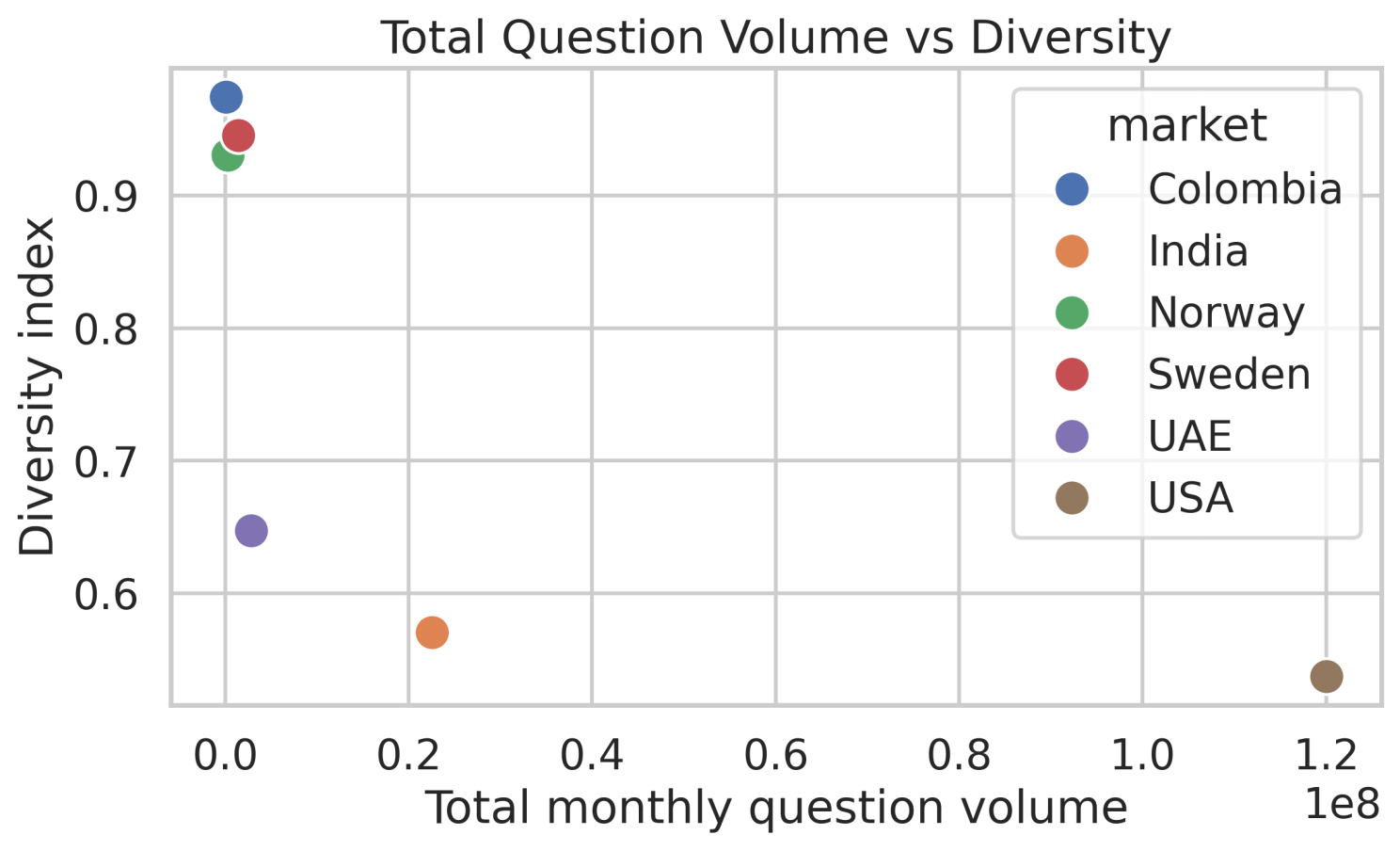
Every record carries a modifier (“how,” “can,” “what,” etc.), the raw query, the market, and the associated cost-per-click. I cleaned the text, normalized volumes within each market, and tagged psychological intent buckets (curiosity, practical help, health anxiety, safety, social). That setup let the USA’s 1.3 million-question mammoth share a stage with Norway’s 1,760 questions, and it exposed both the macro rhythms and the local stories.
The global pattern that shows up before coffee even drips
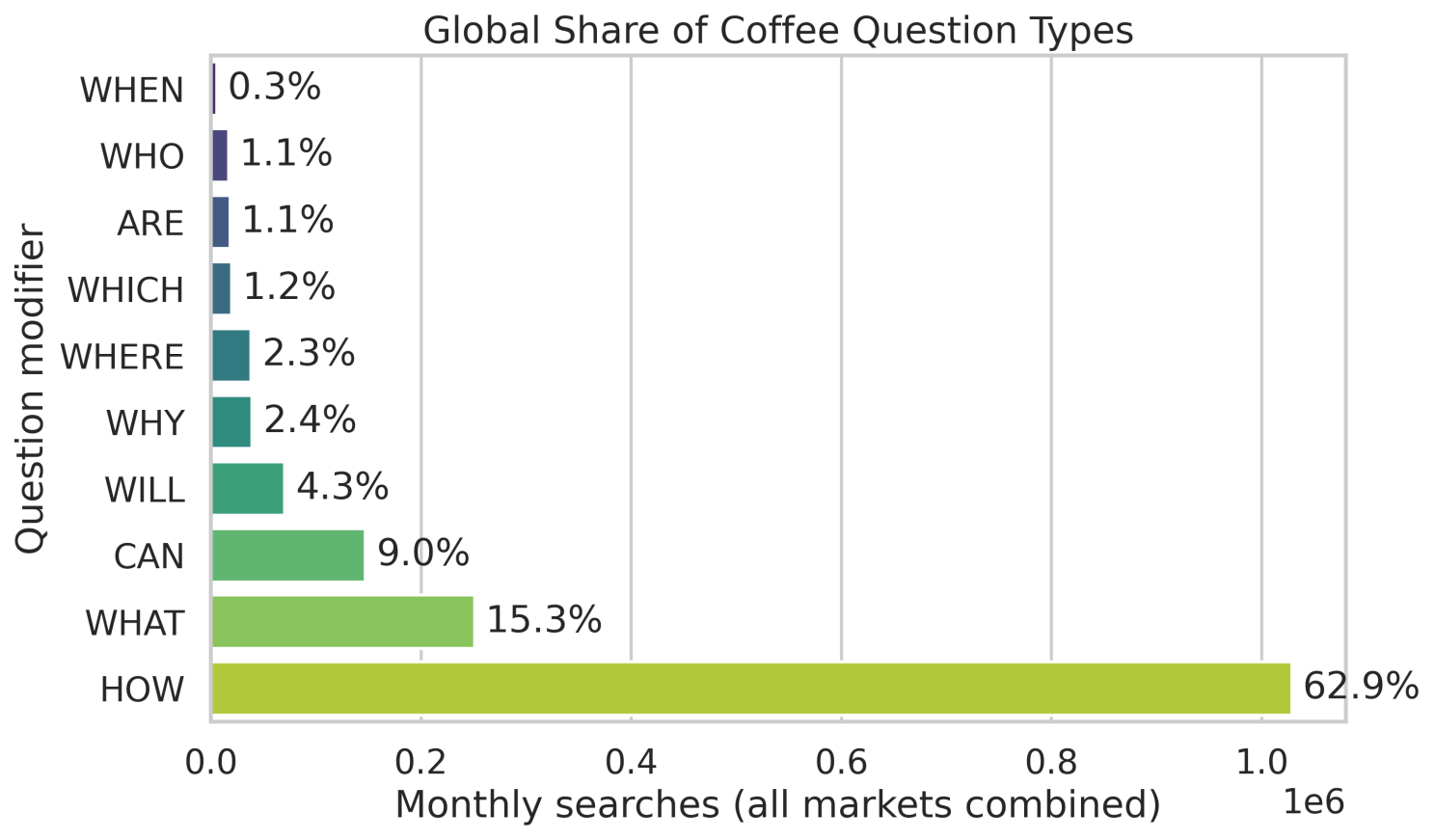
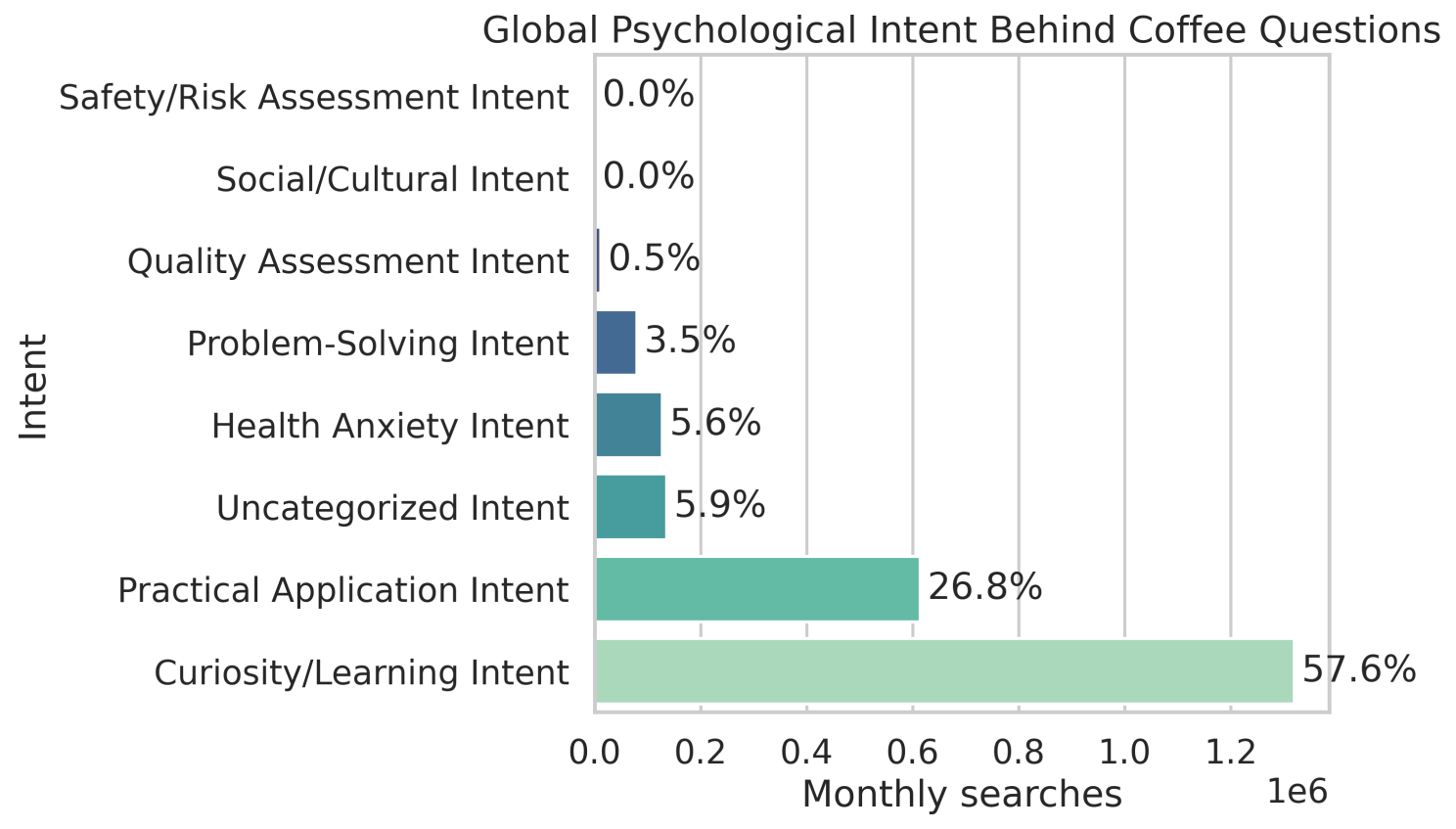
Curiosity leads. Anxiety follows. Reinvention never stops.
- We lead with “how.” Roughly two thirds of all question volume starts with HOW. “How much caffeine is in cup of coffee?” (90,500 searches in the US) and “how make black coffee” (33,100 in India) prove we want clarity before caffeine.
- The worry sneaks in next. Once people know the steps, CAN/WILL/WHY questions pop up. “Can coffee dehydrate you?” pulls 14,800 US searches; Sweden asks “will coffee make you poop?” 50 times a month; Norway checks “how much coffee is too much?” 50 times. Different markets, same double-take.
- Then coffee becomes a tool kit. After the ritual feels safe, searches jump to repurposing: coffee as garden booster, beauty ingredient, cleaning fix. This is where markets diverge, and where brand opportunities live.
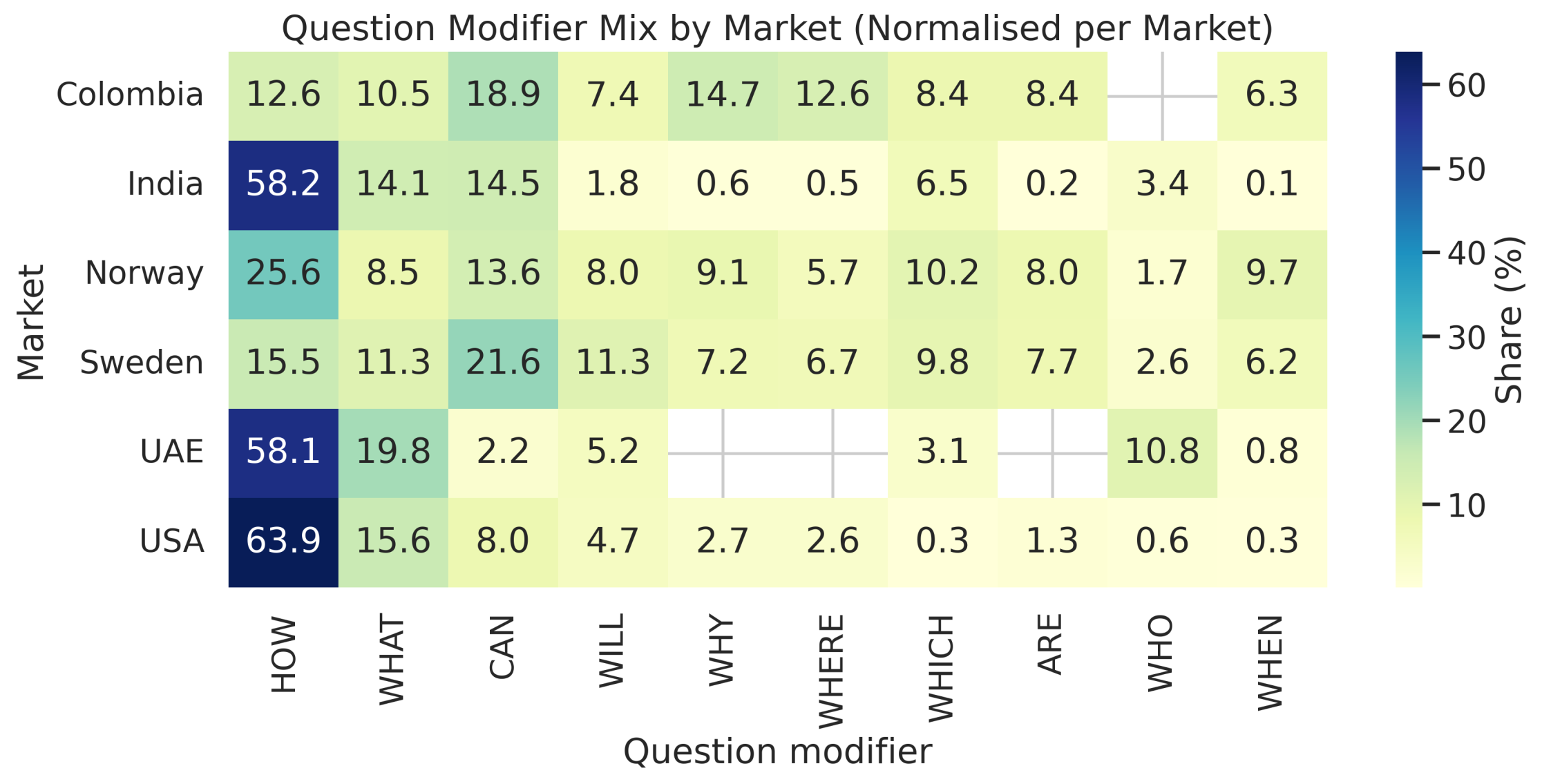
Market moods when you zoom in
United States: caffeine auditors and home maintenance crews.
- 60% of US question volume sits in the Curiosity/Learning bucket , and the top five queries are all caffeine ledger entries. Together they account for more than 300,000 monthly searches.
- Right behind the math comes maintenance: “how to clean keurig coffee machine” and “how do you clean a coffee pot with vinegar” (each 14,800 searches). The morning ritual includes keeping the equipment in spec.
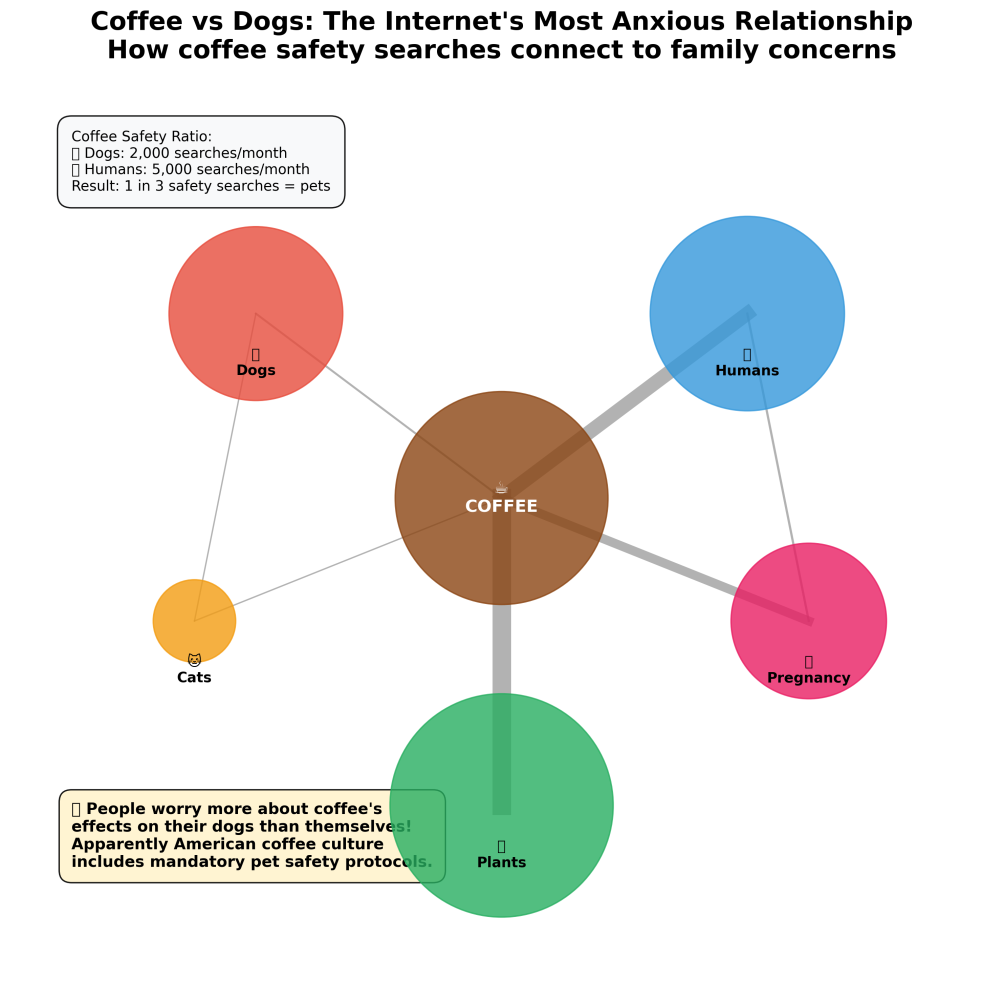
- Even the long tail pays attention to household safety. “Are coffee grounds bad for dogs?” (720 searches) and “dog ate coffee grounds what to do” variants remind us coffee lives alongside families, not just mugs.
India: one part barista school, one part beauty lab.
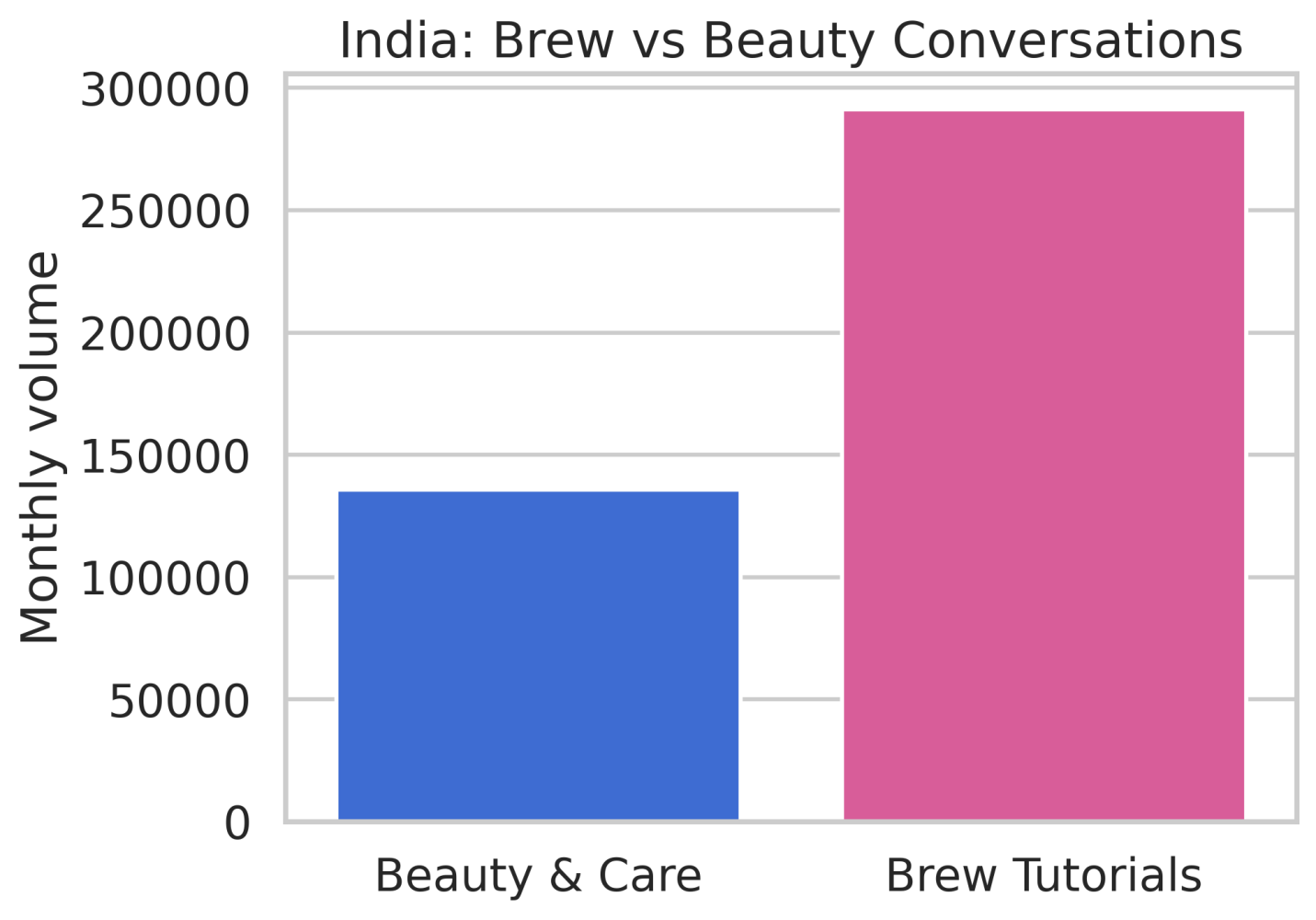
- Curiosity (44.4% of volume) and Practical Application (40.4%) almost tie. “How make black coffee,” “how to make a black coffee,” and “how make cold coffee” sit shoulder to shoulder between 12K and 33K monthly searches.
- Right beside the brew tutorials are beauty experiments: “coffee face mask benefits” (4,600), “coffee body scrub recipe” (4,400), “coffee remove tan” (480). Coffee slips from cup to mirror without warning.
- Health concerns bubble up too: “will coffee cause hair loss” (1,000) so coffee is simultaneously a remedy and a risk, depending on the question of the day.
United Arab Emirates: choreography and status.
- Curiosity commands 53.9% of the volume, but it’s curiosity with ceremony. “How do I make coffee” (480) pairs with “how to make Turkish coffee” (320) and “which coffee is best” (210).
- Data hints that people researching coffee are ready to invest in premium experiences, whether that’s gear, beans, or cafés.
- The top 12 queries include a mix of preparation, product comparison, and cultural definition (“what is coffee”), suggesting people want to speak the language of coffee fluently before they host or order.
Sweden: practical guardianship of the body.
- It’s the only market where Practical Application leads (30.8%).
- The search list reads like a health log: “coffee can increase blood pressure” (50), “can coffee increase blood pressure” (50), “will coffee make you poop” (50), “will coffee dehydrate you” (40).
- Brew basics still appear (“how to make coffee” at 70), but the emotional centre is the body’s response. Coffee isn’t just a drink; it’s a variable in personal wellbeing experiments.
Norway: moderation framed by history.
- Total volumes are small, yet the diversity index is 0.93, meaning Norwegians explore many question types evenly.
- “How much coffee is too much” (50) anchors the list, closely followed by equipment portions (“how much coffee in french press” at 30) and curiosity about origin (“when coffee was invented” / “when was coffee invented,” both 30).
- Health anxiety, curiosity, and heritage sit in balance. Coffee is something to understand fully before it’s enjoyed.
Colombia: everyday pride with a sustainable instinct.
- Even with just 950 total monthly question searches, the spread is wide (diversity index 0.97).
- Top entries include “are coffee filters compostable” (10), “where coffee is grown” (10), “which coffee is best” (10).
- Coffee is both national story and household material. People seek ways to honour it, from farming provenance to compost bins, regardless of the small absolute numbers.
Micro-obsessions that say more than any average
Zooming into specific clusters is where the personality really pops.
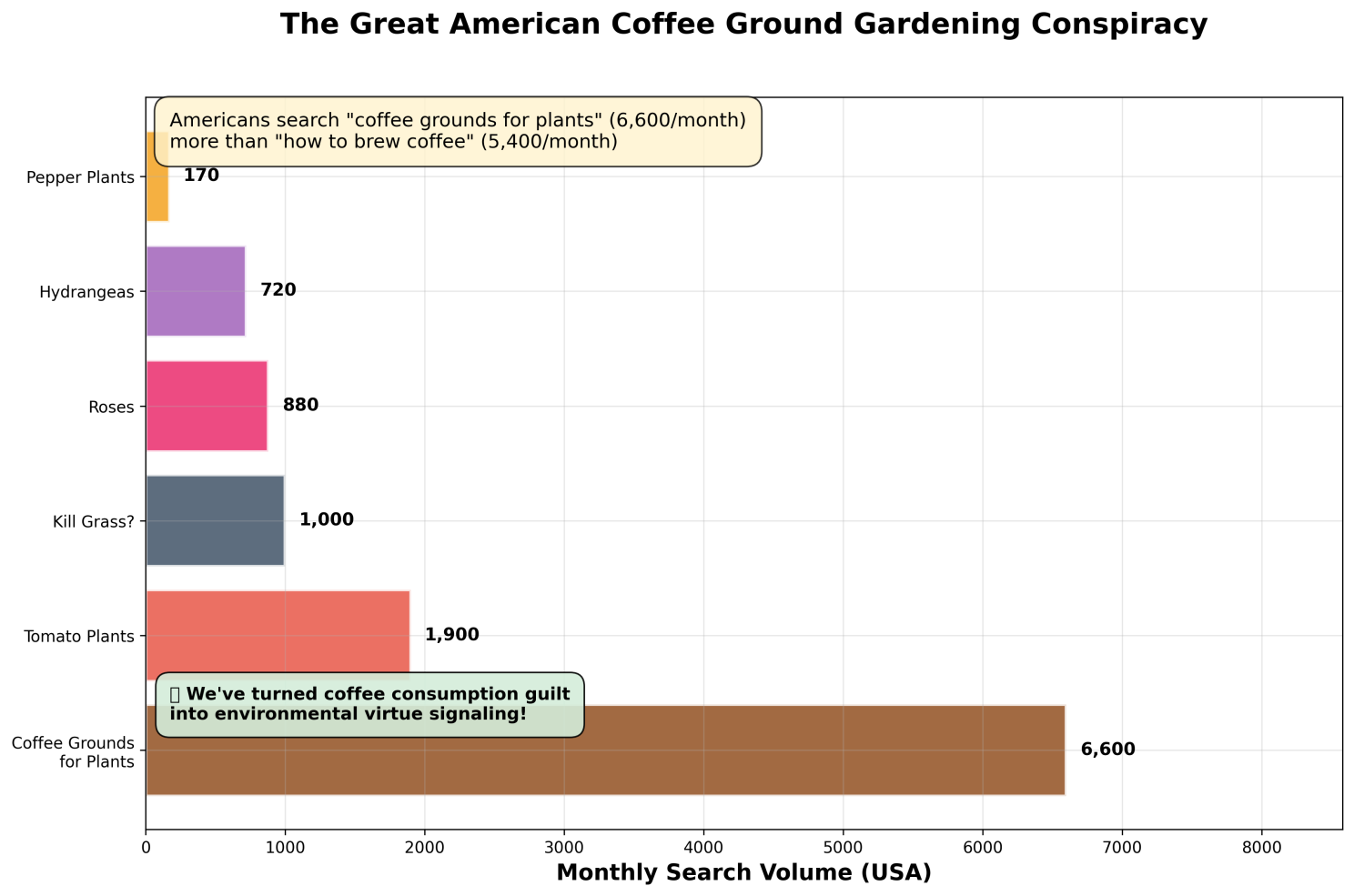
- The American garden redemption arc. Coffee guilt turns into eco-pride every time someone rinses out the basket. “Coffee grounds for plants” (6,600 searches) leads a constellation of plant-specific hopes:
- “Are coffee grounds good for tomato plants?” (1,900)
- “Coffee grounds for roses” (880)
- “Coffee grounds good for hydrangeas” (720)
- “Can coffee grounds kill grass?” (1,000)
It’s a DIY ritual that reframes habit as stewardship: caffeine in the morning, compost hero by afternoon.
Instant coffee’s secret fan club. Despite the latte art era, “instant coffee best” racks up 27,100 searches in the US and 170 in the UAE. Variants probe quality, comparisons, and brand reputations. Instant coffee is the guilty pleasure people research in private, the hedging question that asks, “Is it okay if I like convenience?”
Coffee-as-skincare labs popping up in India. Beyond the headline queries, the gallery includes “coffee scrub for glowing skin,” “coffee for dark circles,” and “coffee face mask DIY” (200–400 searches each). These aren’t once-off experiments, they show up every month, which means coffee is a mainstay in personal care routines, not a fad.
The inevitable poop detective work. Every market contributes to the bathroom canon:
- USA: “will coffee help me poop” (170)
- Sweden & Norway: “why coffee makes me poop” (10 each)
- Colombia & India: “what coffee is made from cat poop” (10 each)
The phrasing changes with culture, but the curiosity is universal: coffee promises regularity, and we keep checking if it delivers.
- Pet safety is non-negotiable in the US. “Dog ate coffee grounds” variants stack alongside “are coffee grounds bad for dogs” (720) and “coffee beans poisonous to cats.” For many households, coffee questions double as safety drills. Pets are part of the caffeine conversation.
The Universal Coffee Weirdness Scale
After analyzing more patterns across 6 countries, some beautifully weird consistencies emerged:
- Winner: Global Coffee Stain Panic
“Are coffee stains permanent?” appears with significant search volume in EVERY SINGLE COUNTRY. From wealthy UAE to cost-conscious Colombia—everyone is equally terrified of permanent coffee marks.
This reveals coffee’s unique position in daily life: it’s simultaneously essential and destructive. We can’t live without it, but we live in constant fear of its staining power.
- Runner-up: The Great Coffee Price Surveillance Network
Coffee price monitoring searches appear everywhere, regardless of:
- Economic development level
- Coffee production vs consumption status
- Local coffee culture maturity
Apparently, coffee price anxiety transcends all cultural and economic boundaries. We are all secretly running personal coffee inflation tracking systems.
- Third Place: Universal Poop Curiosity (yes, really)
Every culture has coffee-digestive searches, but they manifest differently:
- India: “Are coffee poops healthy?” (medicinal angle)
- USA: “Why does coffee make me poop?” (mechanical curiosity)
- UAE: “Coffee effects on stomach” (diplomatic phrasing)
The human digestive system’s response to coffee is apparently humanity’s shared fascination.
The Great Global Coffee Mysteries Nobody Talks About
Mystery #1: The Colombian Coffee Paradox
Colombia produces some of the world’s best coffee, yet Colombians search basic coffee questions at surprisingly high rates:
- “What is arabica coffee?” (240 searches/month)
- “How to make coffee at home?” (180 searches/month)
- “Coffee vs espresso difference?” (120 searches/month)
Plot twist: People in the coffee capital of the world are searching Coffee 101. Either they are researching for export markets, or there’s a hidden population of Colombians who somehow missed the coffee memo.
Mystery #2: The UAE Coffee Business Obsession
UAE has the highest ratio of coffee business searches relative to coffee consumption searches:
- “Coffee shop profit margins” (290 searches/month)
- “Coffee franchise opportunities” (180 searches/month)
- “Coffee import business” (150 searches/month)
Theory: In UAE, coffee isn’t just a drink—it’s an investment opportunity. Every coffee moment includes business potential evaluation.
Mystery #3: The Swedish Coffee Science Project
Sweden searches coffee technical specifications like they are engineering precision instruments:
- “Coffee brewing temperature exact” (210 searches/month)
- “Coffee grind size microns” (85 searches/month)
- “Coffee extraction percentage” (120 searches/month)
Revelation: Swedes have turned coffee into applied chemistry. They are probably measuring coffee pH levels and optimizing extraction ratios like it’s rocket science.
Mystery #4: The Great Indian Coffee Contradiction
India simultaneously searches:
- “Coffee health benefits” (1,200 searches/month)
- “Coffee side effects” (1,600 searches/month)
The contradiction: Indians are researching coffee like it’s both medicine AND poison. Every cup involves a risk-benefit analysis. It’s like coffee comes with a medical disclaimer.
These patterns reveal something lovely:
- We optimize everything (even beverage timing)
- We repurpose everything (coffee grounds become garden magic)
- We worry about everything (including our pets’ coffee safety)
- We beautify with everything (coffee face masks, apparently)
- We are all secretly weirder than we admit (instant coffee curiosity is universal)
Coffee searches tell you more than about coffee. They are about human curiosity, creativity, and our endless ability to find new uses for familiar things.