
I admit this is subject to survival bias as we are only seeing those who succeeded, yet could this data still offer meaningful insights into extreme wealth creation? Thus, I carried out varied analyses, and the patterns that emerged challenge many commonly held assumptions.
Dataset
The dataset contains records for 2,640 billionaires.
Few some interesting baseline stats
- The average billionaire net worth is $4.62 billion
- ~69% are self-made while ~31% inherited their wealth
- Men represent 87% of billionaires while women account for only 13%
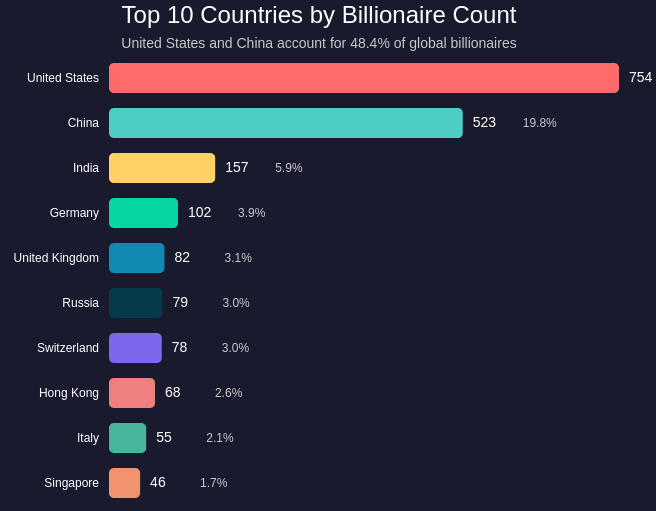
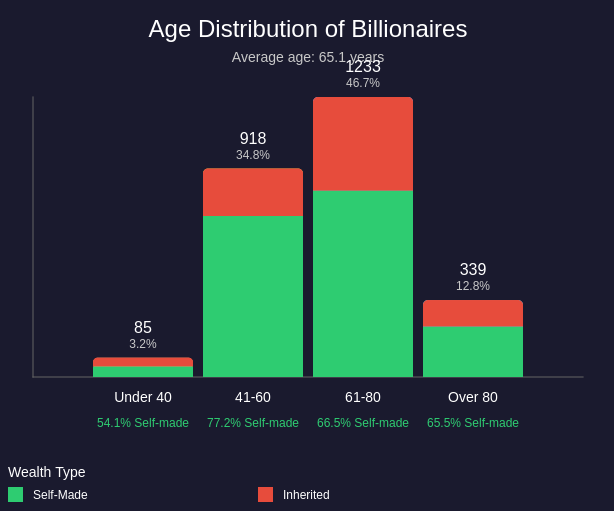
But the real insights emerged when digging deeper into the structural patterns behind these numbers .
Privilege vs. Performance: Why Being “Self-Made” Tells Only Half the Story
We have all heard the narrative: billionaires are either “self-made” or they inherited their wealth. But what if this simple binary misses the much more complex reality of how extreme wealth actually develops? May be what matters isn’t just whether someone inherited money, but the entire ecosystem of advantages they started with.
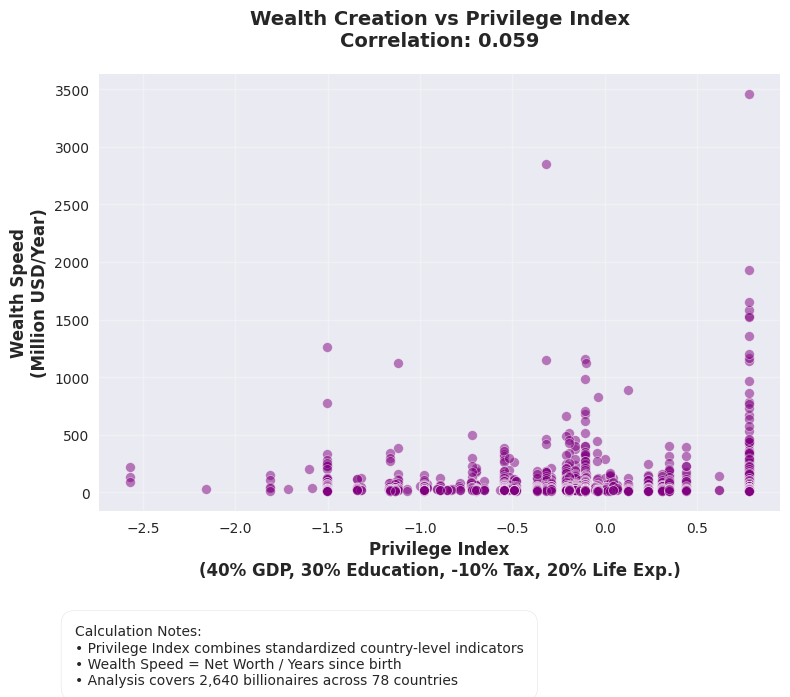
Privilege Index : I created a “Privilege Index” using four variables measuring starting advantages through applies weights - economic environment, educational access, financial freedom (taxes) and development level (life expectancy).
Findings:
- The correlation between privilege and wealth accumulation speed was virtually non-existent (just 6%). This suggests that initial privileges explain almost none of the variation in how quickly people accumulate extreme wealth.
- It also challenges deterministic perspectives that assume ecosystem advantages predict extreme financial success.
- Strategic industry selection in emerging or high-growth sectors appears to be the most powerful factor enabling individuals to overcome privilege disadvantages, as evidenced by out-performers accumulating 5.5x more wealth while coming from less advantaged backgrounds.
Innovation Creates More Billionaires Than Capital Management Alone
Another area to understad is whether wealth creation follows two distinct pathways: “Market Makers” (innovators who create new markets) versus “Market Extractors” (those who optimize returns from existing markets or capital).
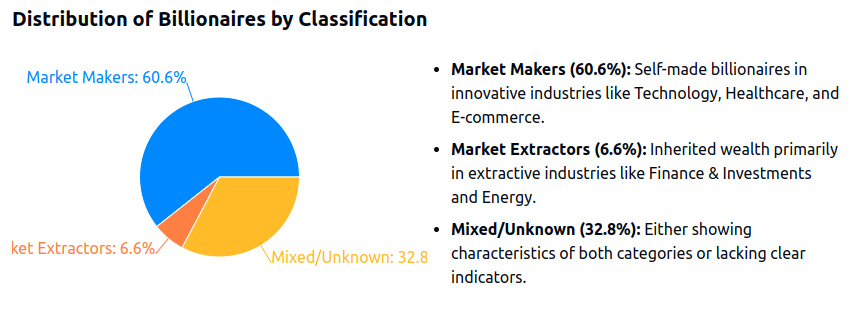
There is fundamental difference in wealth creation pathways between these groups. Market Makers create new value through innovation and entrepreneurship, while Market Extractors primarily inherit and manage existing wealth. Thus, I classified billionaires based on industry type, wealth source keywords, and self-made status.
Findings:
- Market Makers represent the largest group of billionaires (61%), highlighting the dominance of innovation-based wealth creation in the modern economy
- The large Mixed/Unknown category reflects the complexity of wealth creation - many billionaires don’t fit neatly into the maker/extractor classification, provides valuable insight into how wealth creation often involves both market making and market extracting elements.
- Technology, Healthcare, and Fashion & Retail industries are dominated by Market Makers, while Finance & Investments and Energy sectors show stronger presence of Market Extractors.
- Market Makers increased steadily across generations (55% in Pre-Boomers to 65% in Millennials), demonstrating the growing importance of innovation in wealth creation.
- Millennials show a concerning rise in Market Extractors (12.87% compared to Gen X’s 5.57%), suggesting a possible return to inherited wealth dynamics among younger billionaires.
The Gender Wealth Creation Gap Runs Deeper Than Numbers
Analysis also reveal stark gender divide that goes beyond simple representation. While men predominantly created their own fortunes (74% self-made), women largely inherited wealth (71% inherited). This represents the strongest statistical relationship in the entire analysis.
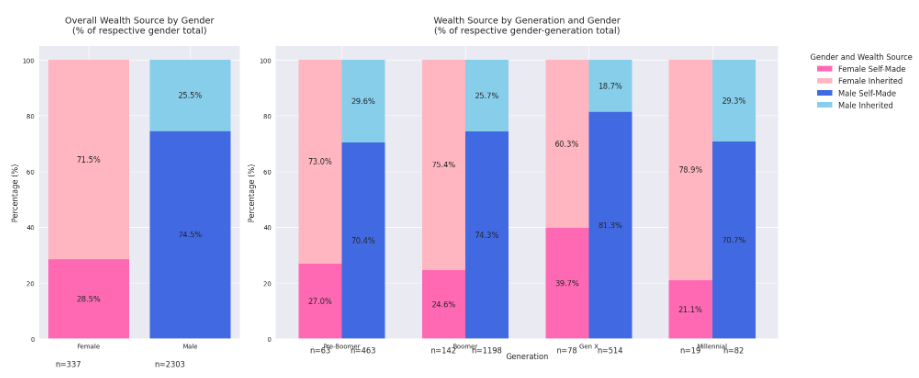
- When examining industry paths, women show higher concentration in consumer-focused industries (Food & Beverage, Fashion & Retail) while men dominate in financial and technology sectors
- Even in the technology sector, where 63% of female billionaires are self-made (the highest percentage for women), this is quite in comparison to the 96% self-made rate for men in the same industry.
There is clear evidence that gender significantly influences both industry selection and wealth creation pathways. The persistence of these patterns across generations, despite some progress in specific sectors, suggests structural factors continue to influence gender-based path dependencies in wealth creation.
Generational Wealth Patterns Show Distinct Signature Industries
Analyzing billionaires across four age groups revealed distinct generational patterns in wealth creation. Each generation shows “signature industries” that reflect the economic opportunities of their era.
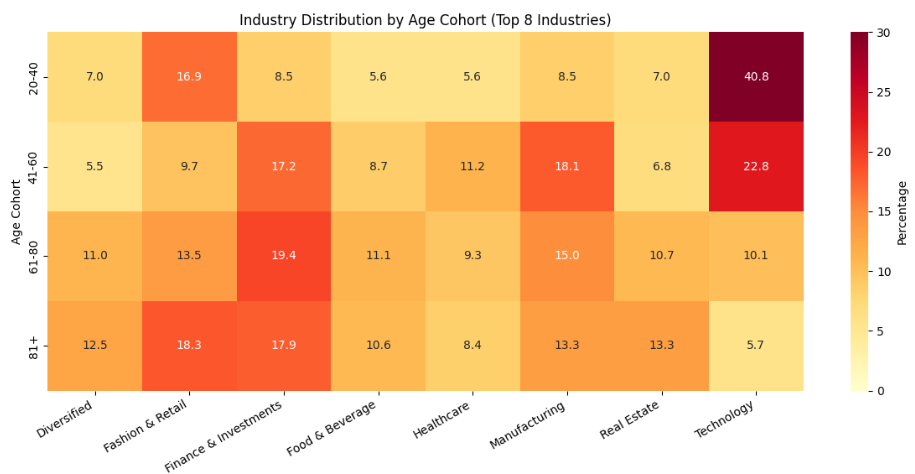
- Young billionaires (20-40) show a massive +22.22% over representation in technology.
- Middle-aged billionaires (41-60) show the highest self-made percentage (77.23%) and strong representation across technology, manufacturing, and healthcare.
- Senior billionaires (61-80) concentrate in diversified holdings, real estate, and finance, while the oldest group (81+) shows the highest concentration in fashion & retail and real estate.
Birth Dates Don’t Determine Billionaire Success
Analysis of 2,640 billionaires definitively refutes the notion that astrological signs or birth dates play any role in wealth creation. The analysis reveals:
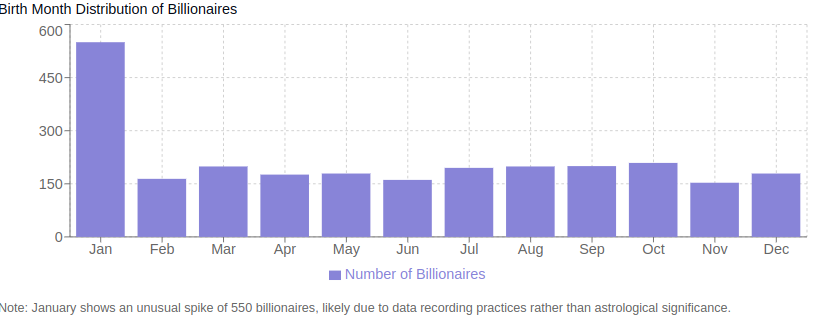
- Zero correlation between birth month and wealth (correlation coefficient: 0.0034)
- Equal self-made success rates across zodiac signs (ranging from 63% to 73%)
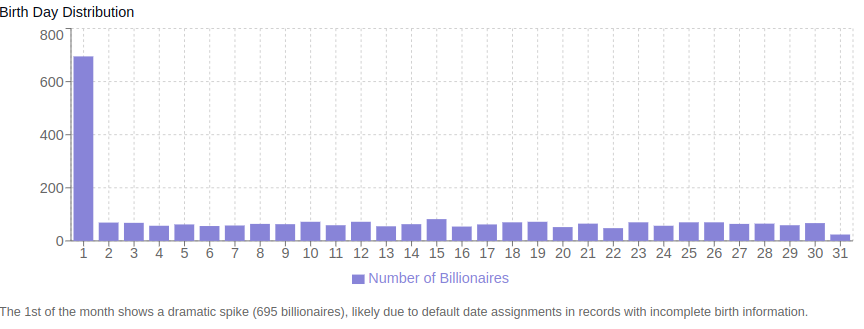
- Statistical anomalies (like January’s spike of 550 billionaires) are explained by data recording practices—defaulting to January 1st when exact birth dates are unknown
- Identical wealth creation patterns across all months when controlling for data recording artifacts
The data convincingly demonstrates that wealth creation depends on factors like industry choice, economic environment, and generational opportunities - not celestial positioning at birth. Success in the billionaire class stems from talent, timing and opportunity, not sun signs or numerology.
Data source: Nidula Elgiriyewithana. (2023). Billionaires Statistics Dataset (2023) [Data set]. Kaggle. https://doi.org/10.34740/KAGGLE/DSV/6570253